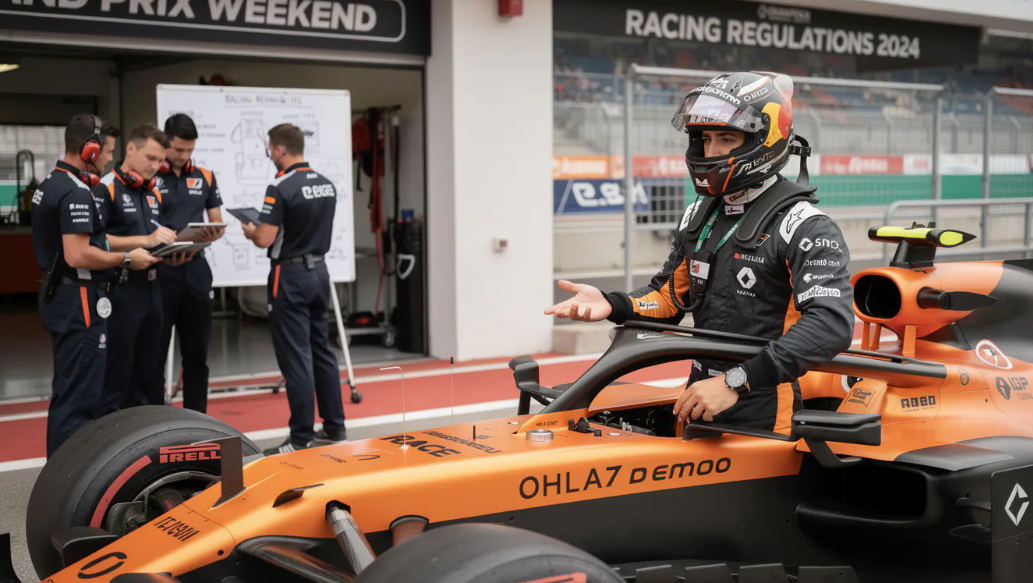
There have been many discussions concerning the new Formula 1 engine rules following the Miami Grand Prix. World champion Lando Norris gave an unequivocal opinion on the issue after the Miami race. While there were several adjustments made to address energy management in qualifying and races, Norris claimed that there was no change to the fundamental issue. In his opinion, the only solution would be eliminating the hybrid power unit’s battery-intensive aspect. These remarks have increased the pressure on the governing bodies of F1 and FIA to consider another path.
Though the changes made in Miami have had a slight effect on the ability of the drivers to use their electrical energy, Norris felt they were inadequate. Lando Norris came in third position in the Miami Grand Prix, yet he felt that the current rules hindered drivers’ natural racing. His frustration reflects a wider concern among drivers about the balance between battery power and the combustion engine.
Lando Norris mentioned about his cautious approach, as he said, “If you go flat out everywhere and you try pushing like you were in previous years, you still just get penalised for it… You just have to get rid of the battery.”
Lando Norris Calls for Radical Changes
Some modifications were made in Formula 1 regarding the battery recharging system used in the Miami Grand Prix. The intention was to minimize the instances where the drivers have to slow down to recharge the battery. According to Norris, the modification made some difference, but not much. It was an attempt by the organizers to create conditions that felt more realistic during the qualifiers and races.
Norris’ complaint does not merely relate to minor modifications. He thinks that the issue lies within the set regulations. Unless the battery management becomes less significant, the drivers will always be restricted by energy objectives instead of speed objectives.
Technical and Strategic Limits of Current F1 Battery Rules
In the case of the 2026 rules, the division of power between the internal combustion engine and the electric energy is roughly even. This has led to uncertain races for many drivers. Drivers who have utilized excessive battery while trying to pass other drivers will be susceptible once their remaining energy supply depletes.
As stated by Oscar Piastri, “the closing speeds were pretty crazy.” George Russell had been trailing behind him by one second. However, he managed to pass him once they arrived at the straight line. According to Kimi Antonelli, there needs to be great trust in the speeds due to the reduced reaction times with active aero which makes the cars slower to react when changing direction.
Norris expressed his concerns about the recently concluded GP, as he said, “There’s only so many things you can change with the hardware we have.”
Potential Impact on F1 Racing and Championship Dynamics
F1 teams have already agreed in principle to alter the engine balance for 2027. The combustion engine is expected to gain 50kW, while electric output will be reduced by the same amount. That would shift the power split closer to 60-40 in favor of the engine, reducing dependence on battery deployment.
Still, Norris wants a more fundamental change. His preferred solution may not arrive until 2030 or 2031, when the FIA is considering V8 engines with limited electrification. Such a move could restore a simpler driving style and reduce the tactical complexity that many drivers dislike.