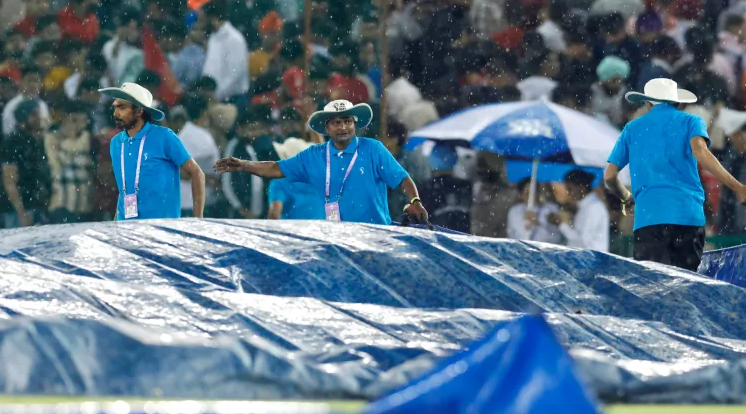
There is no halt to cricket owing to rainfall anymore. Rather, cricket adopts a numerical contest that involves the use of the Duckworth–Lewis–Stern (DLS) approach. The approach is applied in limited-over cricket matches whereby the calculation of the targets that have been interrupted owing to the weather conditions is made according to the method. It is used to ensure that there is no bias for either of the teams during matches that have faced interruptions during play. With the advancement of ODI and T20 formats, the method has assumed much importance in producing the result.
This method was invented in 1997 by Frank Duckworth and Tony Lewis, two statisticians who were from England. They developed this technique following criticism of the previous techniques used in the 1992 World Cup. In 1999, the International Cricket Council recognized it as a legitimate formula. Subsequently, the method was updated by an Australian statistician Steven Stern, which resulted in its renaming as Duckworth-Lewis-Stern in 2014.
The Two Resources Every Team Has
The DLS method is based on a very simple concept used in cricket. In all innings, the batting side begins with two resources: 300 balls for a 50-over match and 10 wickets. The resources become smaller as the number of overs becomes lesser or wickets fall.
The scoring capacity of a team having 40 overs to go along with eight wickets is higher than a team with 40 overs to go and only three wickets to lose. Therefore, interruptions will have varying impacts on the teams based on the weather conditions prevailing during the interruption.
Why Rain Changes Targets Differently
Timing of the rainfall is critical in DLS calculation. The loss of overs later on during the innings causes greater damage because teams tend to be more aggressive towards the end of their innings. Also, when a team has wickets in hand, it will play aggressively compared to the other side that is in difficulty.
For instance, when a team has been reduced to 80/6 after 20 overs, a rain break might actually help such a team. This team would have lost most of its batting power, while the chasing team will miss some overs to build up its innings. In such cases, DLS can reduce the second innings target despite identical overs for both teams.
The Logic Behind Resource Percentages
These figures have been determined beforehand in resource tables, which have been sanctioned by the ICC. Each match scenario is translated into a percentage figure based on the number of overs left to play and the number of wickets lost.
If a side has 50% of its batting resources left, it means that DLS will assume that the team has 50% chances to score close to half of what a full-strength innings might have scored. These figures are not speculated upon during any game; rather, they have been gathered from past performance data.
The Formula That Sets Revised Scores
The central DLS formula is straightforward: Suppose Team A scores 250 in a full 50-over innings. Rain then reduces Team B’s chase to 25 overs. If Team B is considered to have 50% resources available, its revised target becomes 125. Therefore, Team B would need 126 runs to win.
The formula changes slightly if interruptions happen during the chase. In that case, officials calculate a par score before setting a new target.
Par Score and Target Are Not the Same
DLS separates “par score” from “target score.” A par score is the score a chasing side should have reached when rain stops play. The target score is the revised total after play resumes.
For instance, if rain permanently stops a chase after 20 overs, officials compare the batting side’s score with the par figure linked to wickets lost. If the chasing side is ahead of par, it wins. If not, the team batting first takes the match.
Why DLS Replaced Simple Run Rate
Previous models considered only the runs per over formula. But they didn’t factor in any aspect of wickets. This led to biased outcomes because the side having plenty of wickets was no better off than the one losing all its batsmen quickly.
This limitation was overcome by DLS. It considers both overs and wickets, thus providing a more realistic computation. Another advantage is the model’s assumption of how sides would have batted if they had known they were going to lose some overs. That balance is why DLS remains the ICC’s standard method for rain-hit matches worldwide.