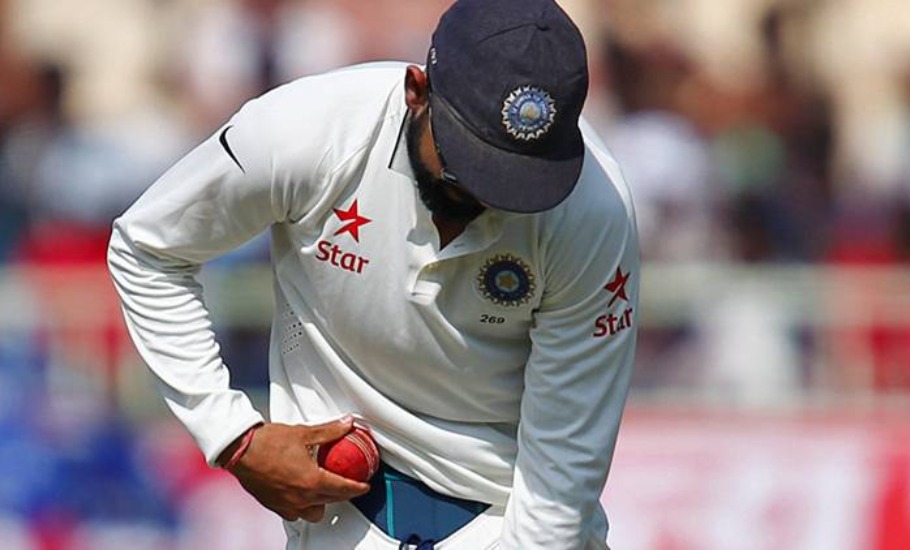
The soft-spoken notion of a controversial topic is turning into an uproar. While cricket has its roots deeply embedded in the past, there is now a voice questioning its essence. Dawid Malan, who was formerly an international English cricketer but quit playing internationally in 2023, has suggested controlled legalization of ball tampering to achieve symmetry in today’s game of cricket. Appearing on a BBC podcast, Malan pointed out how bowlers are increasingly falling behind the eight ball. He stated that legalization will help bring back the art of reverse swing to close games, especially the final overs.
In his own words, Malan’s suggestion is quite obvious. He mentioned that he discussed the concept, and there have always been efforts to manipulate the ball in cricket.
While giving his own perspective in support of all the bowlers, he said, “I actually think you should legalise it, like just let people scratch the ball.”
However, he added a clear boundary: no foreign objects. For him, reverse swing remains a skill worth protecting in an era dominated by batters.
Support from the Fast-Bowling Legend
However, it must be emphasized that it is not a new idea. The former fast bowler from South Africa, Allan Donald, had made similar remarks. He cited flat wickets and the fading advantage of pace bowlers.
“We do need some sort of defence mechanism,” Donald said, suggesting that preparing the ball could help bowlers compete with batters and make the game even. However, he also admitted such a rule change would likely never be approved.
Likewise, there have been other voices in the cricket world who have pointed out the same issue. It is not that all of them were in favor of tampering but their worry was quite similar in that they thought the batters had too much control. There has always been an emphasis on bringing back a “50-50 battle.”
Alternative Ideas and Debate
On the other hand, there have been some innovative ideas by the present-day cricketers. The English player Joe Root has come up with a ball-changing strategy to solve issues related to quality while keeping the basic format of the game unchanged.
In spite of this, what makes Malan’s proposal distinct is its boldness. In his view, ball-tampering should not be regarded as cheating but as skill control. By his logic, manipulating the ball to make it move falls within the art. As the sport advances, questions about the future direction of cricket arise.